Market data quality
Point-in-time integrity, provenance, corporate actions, missingness, and the cost of incorrect assumptions.
I’m a Czech informatics student working with financial models, market data, Python, and research software. Here you can inspect the methods, code, results, and limitations behind my work.
Based near Prague · Open to research, quantitative, data, and engineering opportunities
A small set of technical artifacts with explicit scope, methods, contribution, reproducibility, and boundaries.
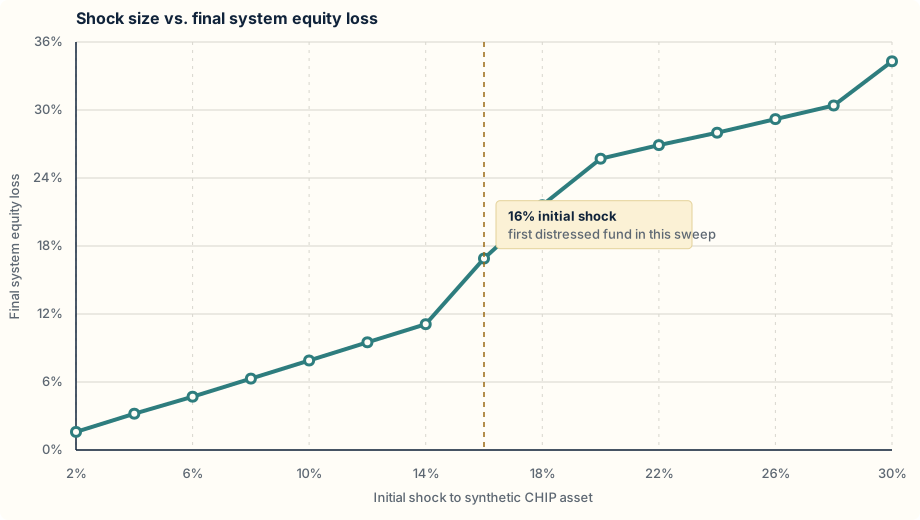
View all selected workA deterministic Python simulation of how leverage, margin pressure, forced liquidation, and endogenous price impact can amplify a shock across overlapping synthetic portfolios.
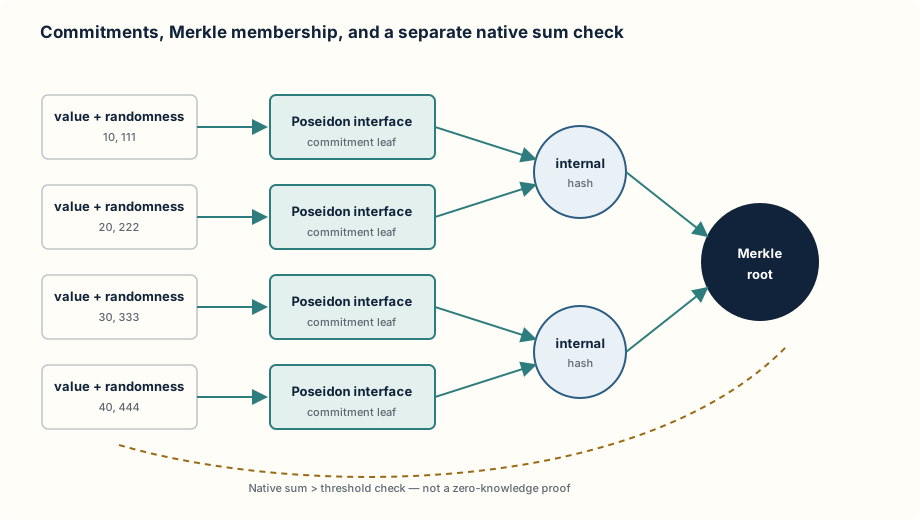
A public Rust/arkworks prototype for commitments, Merkle roots, and membership proofs. The case study separates the repository’s capabilities, my documented contribution, and its non-production limitations.
The priority is not publishing frequently. It is producing a small number of technically defensible artifacts with point-in-time data, reproducible methods, realistic constraints, and honest limitations.
Point-in-time integrity, provenance, corporate actions, missingness, and the cost of incorrect assumptions.
How leverage, margin, spreads, depth, and forced selling alter outcomes when conditions deteriorate.
Drawdown, concentration, correlation shifts, tail events, and decision rules that keep a system alive.
Versioned data, deterministic runs, tests, experiment logs, and software that makes claims inspectable.

I study Informatics at the Czech University of Life Sciences Prague and spent the 2025–2026 academic year at the University of Wisconsin–Madison, where my coursework included finance, economics, financial modeling, industrial engineering, and computer science.
My current work focuses on building stronger quantitative and research-engineering foundations through reproducible projects, careful data work, and explicit validation.
I am most useful when the task is to define a question precisely, build the analytical workflow, test assumptions, and communicate what the result does—and does not—support.
Read more about my backgroundFor a concise overview, download the one-page résumé. The HTML CV and academic CV provide a fuller, dated record of education, projects, technical skills, and supporting links.